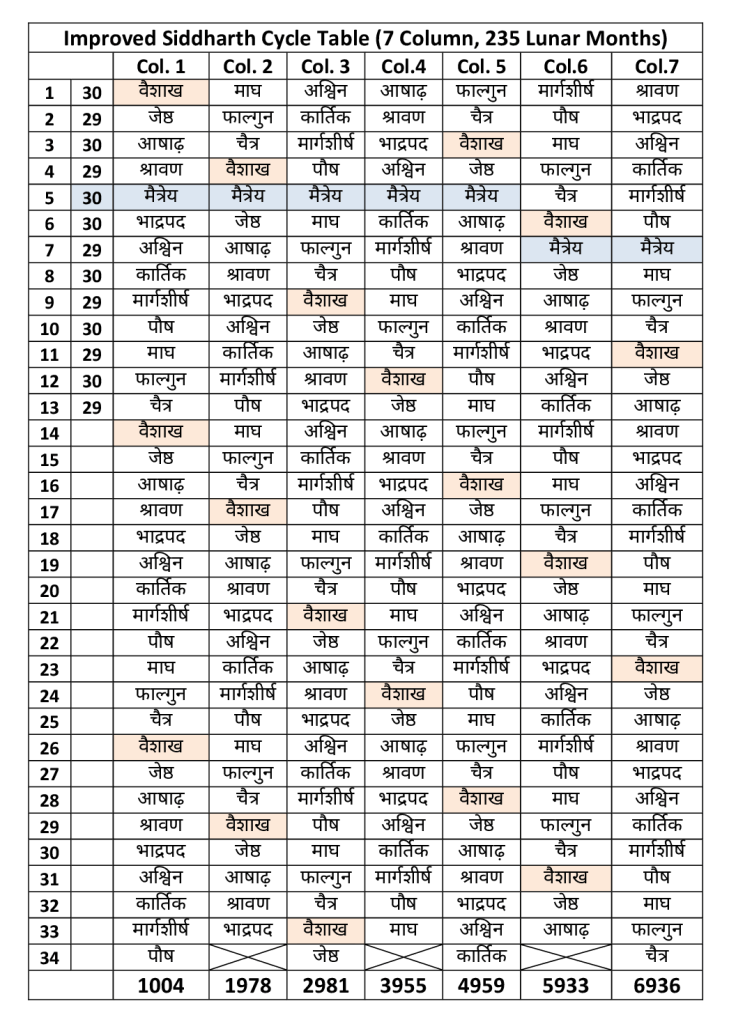
This Calender system is based on 19 years cycle. This system says there are 235 Lunar months in 19 Solar years. This means 19 x 12 = 228 solar months are equivalent to 235 Lunar months. For proper implementation of these 7 extra lunar month’s anomaly, specially modified table of 235 months in 7 columns is created and it is called Siddharth Chakra. Every column is having one extra lunar month. This intercalary month is called “Maitreya” i.e. मैत्रेय. From column Nos 1 to 5 fifth month is Maitreya and column Nos 6 & 7 seventh month is Maitreya. This arrangement gives “Vesak Purnima” approximately at fixed time of the year (i.e. Full moon day of the month of May). Below is the Improvd Siddharth Cycle Table comprising 235 Lunar months in 7 Columns.
Let’s write each year of our Siddhartha Cycle chart of 7 Columns in a new chart of 13 Rows (1 per lunar Month) and 19 columns (1 per year). This chart is the Siddhartha Cycle 19 Year Column Chart, which will look something like the following.
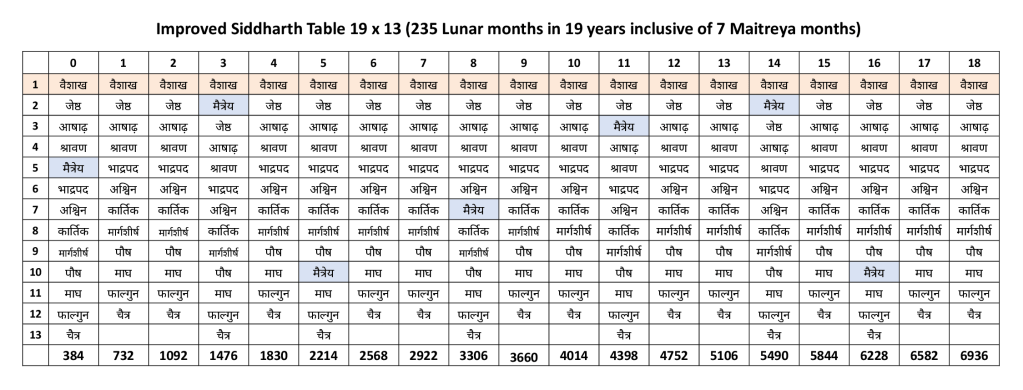
The Siddharth Chakra contains total 6936 days, (as we are considering 354 days per year, calculating 29.5 days per lunar Month i.e. 29 & 30 days every alternate month), Thus, 354 x 19 = 6726 plus 30 x 7 = 210 (30 days per month for 7 extra Months) Total= 6936.
But the 19 years are having 19 x 365.2425 = 6939.6075 days. This creates 6939.6075 – 6936 = 3.6075 days deficit per 19 years or 360.75 days per 1900 days. ≈ 361 days per 1900 years. To compensate this deficit, following process is done. If we divide 1900 ÷ 5 = 380 and further if we subtract 19 from this 380, we get 380 – 19 = 361. So, if we add 1 Intercalary day per 5 years, but Not in Century year (19 Century years), these 361 days deficit is compensated correctly.
But this is with 29.5 days per Lunar Month. Actually, Lunar Month is of 29.53058 days. To compensate this deficit of 0.03058 days further adjustment is made by adding 1 intercalary day in the year ending with 200, 400, 600 and 800. We will see this in point no 12 on next part. This is done by actual observation of the system.
Quick Reference Guide for Bodhi Samvachara
- Bodhi Samvachhar begins on Sunday, Tej Prathama Vaisakha Bodhi Samvachhar 0001, which is April 18, 516 BCE, according to global chronology. (CE)
- The lunar month begins on the day after the new moon and ends on the next new moon. (Amanta lunar month)
- Each lunar month will have two parts: Tej Paksha (bright phase) from the new moon to the full moon, and Tama Paksha (dark phase) from the full moon to the next new moon. A year consists of 12 such months.
- The months of Vaisakha, Ashadha, Bhadrapada, Kartik, Paush, Phalguna, and Maitreya will have 30 days.
- The months of Jyeshtha, Shravan, Ashwin, Agrahana (Margashirsha), Magha, and Chaitra will have 29 days. There will be No Tama Ashtami (8th Tithi of dark phase) in these months.
- The 19-year cycle will be called the Siddhartha Chakra and will contain 235 lunar months.
- The Siddhartha Chakra will have seven parts, each part called a Maitreya Stambha. Maitreya Stambhas one through seven will have 34 and 33 lunar months alternately, and each Maitreya Stambha will have one Maitreya month.
- The position of Maitreya month in the Samvachar, will be calculated from the previous Samvachar number (as per the Siddhartha Cycle 19-year table) using the following rules:
- @(Samvachar number – 1) ÷ 19. Note down remainder value after division in integer value only. [@ – This calculation is the number of complete Years passed till the desired date.]
- If the remainder is 0, the fifth month will be Maitreya month.
- If the remainder is 3, the second month will be Maitreya month.
- If the remainder is 5, the tenth month will be Maitreya month.
- If the remainder is 8, the seventh month will be Maitreya month.
- If the remainder is 11, the third month will be Maitreya month.
- If the remainder is 14, the second month will be Maitreya month.
- If the remainder is 16, the tenth month will be Maitreya month.
- If there is any other remainder, there will be No Maitreya month in that Year.
Ashok Samvachhar Calculation
10. If the last digit of the running Samvachhar is 0 or 5, then this Samvachhar will be an Ashoka Samvachhar.
11. If the last two digits of the running Samvachhar are 00, then this Samvachhar will not be an Ashoka Samvachhar even though the last digit is 0.
12. If the last three digits of the running Samvachhar are 200, 400, 600, or 800, then this Samvachhar will be an Ashoka Samvachhar even though last two digits are 00. (That is, if the last three digits are 100, 300, 500, 700, 900, and 000, then this Samvachhar will not be an Ashoka Samvachhar.)
13. In the Ashoka Samvachhar, the month of Chaitra will have 30 days instead of 29.
14. The total number of days from the Epoch (start day of the Bodhi Samvachhar) to any day will be called Bodhi Dinank. (This is similar to the Julion day number in Common Era system.)
There will be 19 Ashoka Samvachhars every 100 years (1 per 5 years block), and 2 Ashoka Samvachhars will be added every 500 years. That is, (total Samvachhars ÷ 5) – total century + (total Samvachhars ÷ 500) x 2. This number will be the same as the total Ashoka Samvachhar. (Integers only)
The concept of Bodhi Dinank
Similar to the Julian day number in global temporal chronology. Julian day number is the number of days from January 1, 4713 BC, to the desired Christian date. Bodhi Dinank is the number of days from April 18, 516 BC, to the desired day.
The Bodhi Dinank (Number) for any date in any Bodhi Samvachhar is very useful for us. It is also used to find out the Weekday of any Bodhi Samvachhar date (Tithi). To do this, divide the Bodhi Dinank number by 7, and match the Remainder with the following table’s 1st row, and you will get Weekday in corresponding second row.

Any normal Samvachhar has 354 days. A normal Ashoka Samvachhar has 355 days. If the Samvachhar has Maitreya month, then that Samvachhar has 384 days. If the Ashoka Samvachhar has Maitreya month, then that Samvachhar has 385 days.
The complete details of this system is available in a PDF file “Bodhi Samvachhar” on back page.

